Welcome to our agro farming site . Here you can get the proper solution of your agro farming problem. We offer you enough information and guideline of modern cultivating system. We try to find out the proper way of farming that gives you maximum output. We research and analyze your farming related problem and provide proper guideline how to overcome it. We research and review of different farming tools and suggest you which tool is perfect for your farm, Lawn, And Garden. In this case we today we review Best Drip Irrigation Hose For Garden which best for Outdoor Gardening or Outdoor farming. And provide the full buying guide so that you may easily choose the perfect on for you.
Keeping a garden hydrated without wasting water or standing around with a hose comes down to choosing the right tubing for the job.
Whether you’re feeding a few potted plants on the patio or running lines through a full vegetable bed, a well-built drip irrigation hose for garden use delivers water straight to the roots instead of soaking the walkway between rows. That precision matters more than it sounds: less runoff means healthier plants, fewer weeds, and a noticeably lower water bill over a growing season. The tricky part is that “drip tubing” covers a wide range of products, from blank distribution line you punch emitters into, to ready-made soaker hoses you can hook up and forget about.
To make the decision easier, we looked closely at five popular options that cover different budgets, garden sizes, and skill levels while narrowing down the best drip irrigation hose for garden projects of any size. Below you’ll find a quick comparison table followed by a detailed breakdown of each product, so you can match the right hose to your setup before you dig in.
Our Top Picks
5 Best Drip Irrigation Hose For Garden Review
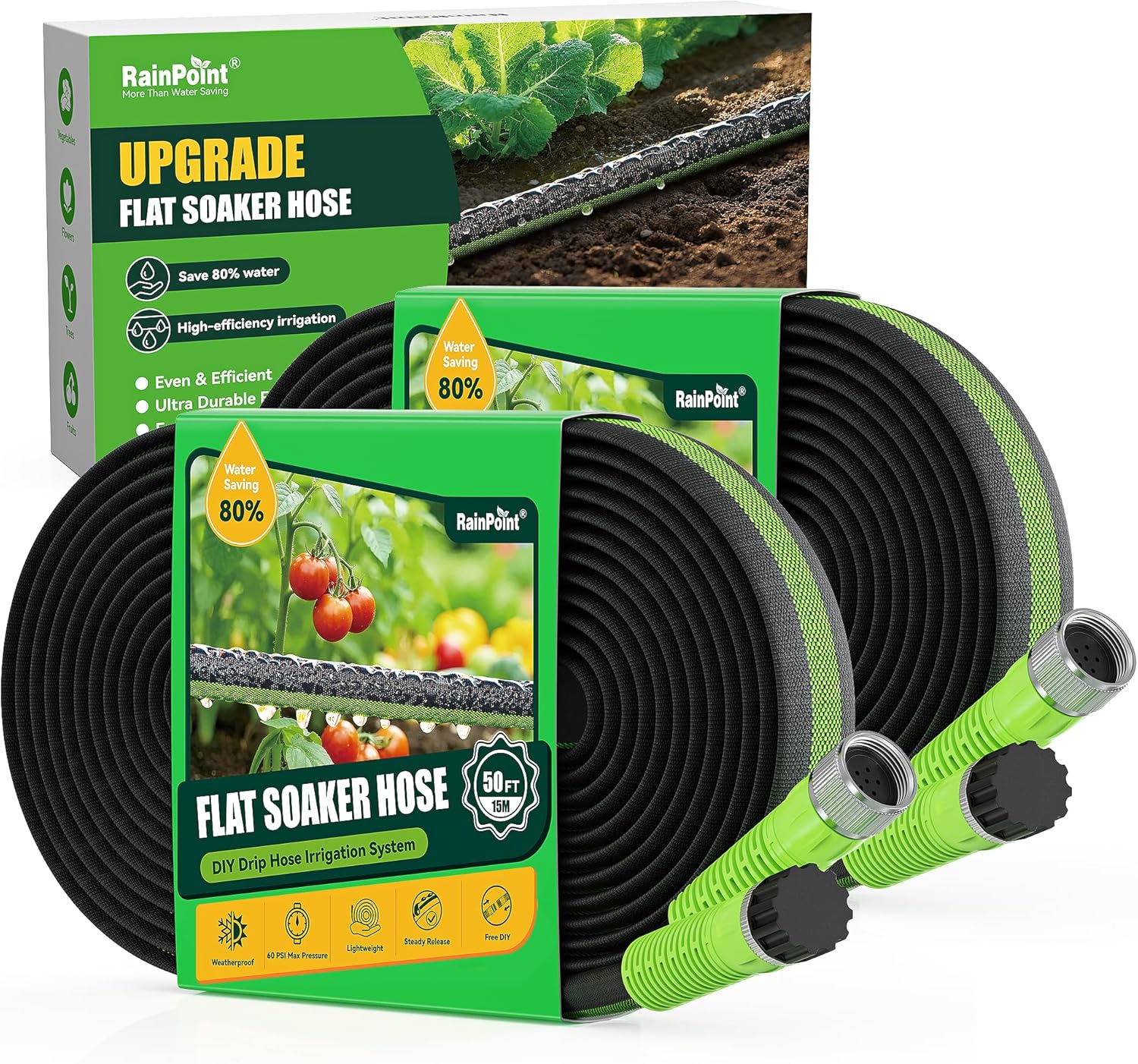
1. RAINPOINT Flat Soaker Hose 100FT with Anodized Aircraft Aluminum Ends – Best Overall
PROS
- +Rustproof anodized aircraft aluminum fittings resist corrosion long-term
- +360° swivel inlet makes faucet hookup fast and hassle-free
- +Flat, kink-free profile routes easily around beds and containers
- +Ships as two 50FT lengths, so shorter runs are easy to manage
CONS
- −Manufacturer advises against linking more than 100 feet in one run
- −Needs steady 40-60 PSI for even soaking, so a pressure regulator helps
SPECIFICATIONS
| Length | 100 ft total (two 50 ft linkable sections) |
| Connectors | Anodized aircraft aluminum, 3/4″ standard threaded, 360° rotating inlet |
| Design | Flat, double-layer soaker hose |
| Recommended Pressure | 40-60 PSI for even soaking |
| Color | Green |
The RAINPOINT soaker hose stands out because it pairs a genuinely flexible, kink-resistant flat design with metal fittings instead of the plastic connectors most soaker hoses ship with. That combination alone puts it ahead of similarly priced kits.
In real garden use, the 360° swivel inlet takes the guesswork out of hooking up to a faucet or timer, and the hose lays flat under mulch without fighting back. Two 50-foot sections give you flexibility to run shorter zones instead of committing to one long line.
It’s the strongest all-around pick for anyone who wants a ready-to-use system rather than raw tubing they have to punch emitters into, making it well suited to raised beds, vegetable rows, and foundation plantings alike.
Get the RAINPOINT Flat Soaker Hose 100FT at Amazon
2. Raindrip 052020P 1/2-Inch Drip Irrigation Water Supply Tubing, 200-Foot – Best Value

PROS
- +200 feet of tubing covers large gardens without buying multiple rolls
- +Multi-layer poly construction uses 100% virgin material on inner and outer layers
- +Works as a main line, feeder line, or with punched-in emitters
- +Backed by a trusted brand that’s supplied landscapers since 1972
CONS
- −Blank tubing means you’ll need to buy emitters and fittings separately
- −No connectors or fittings included in the box
SPECIFICATIONS
| Length | 200 ft coil |
| Outside Diameter | 0.620 in |
| Inside Diameter | 0.520 in |
| Material | Black polyethylene, layered construction |
| Best Used As | Main supply or feeder line |
If your priority is covering a lot of ground for the least money per foot, the Raindrip 052020P is hard to beat. A single 200-foot coil is enough to serve as the main supply line for a sizeable vegetable garden or a cluster of raised beds.
The layered poly construction, with 100% virgin material on the inner and outer walls, holds up well against UV exposure and repeated seasons outdoors, and it connects easily to standard 1/2″ Raindrip fittings and emitters.
Because it’s blank tubing rather than a finished kit, it’s best suited to gardeners who don’t mind adding their own connectors and emitters, or who already have some drip components on hand.
Get the Raindrip 052020P 1/2-Inch Drip Irrigation Water Supply Tubing, 200-Foot at Amazon
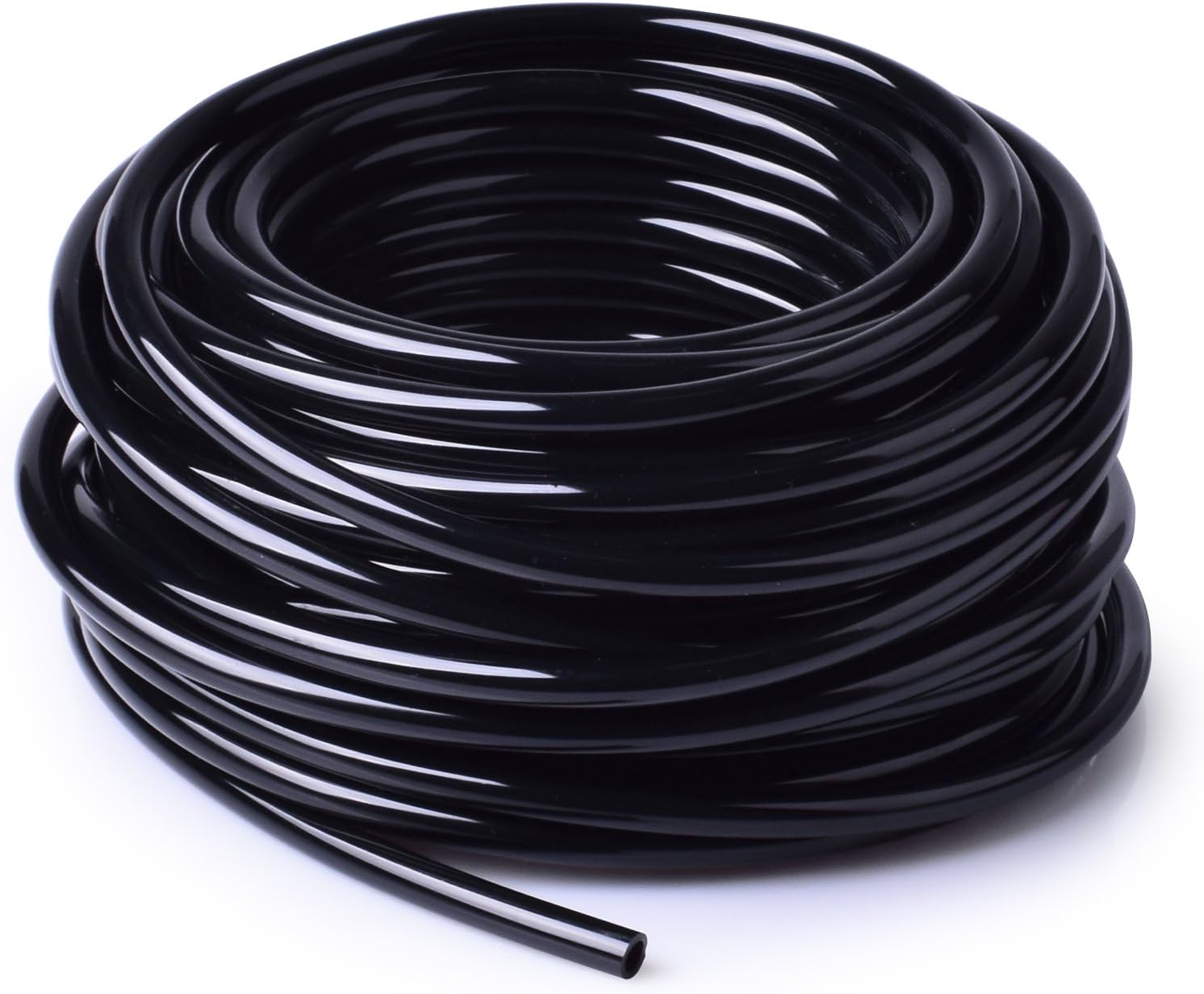
3. MIXC 1/4 Inch Blank Distribution Tubing Drip Irrigation Hose, 50ft Roll – Best Budget Pick
PROS
- +Very affordable entry point into a drip system
- +Extra-flexible construction allows tight turns with fewer elbows
- +UV inhibitors let it stay outdoors year-round, buried or on the surface
- +Compatible with most standard 1/4″ barbed fittings and emitters
CONS
- −Best suited to small, close-range watering rather than large layouts
- −Some users found the tubing firmer than expected when connecting fittings
SPECIFICATIONS
| Length | 50 ft roll |
| Outside Diameter | 1/4 in |
| Inside Diameter | 0.17 in |
| Material | Linear low-density polyethylene with UV inhibitors |
| Coverage | Roughly 15-20 square meters per manufacturer notes |
For gardeners just getting started or watching every dollar, the MIXC 50-foot roll is an inexpensive way to test out a drip system before committing to a larger setup. It’s small, light, and easy to cut to length with a basic pair of scissors.
The tubing’s flexibility is a genuine advantage in tight planting areas, letting it snake around containers and raised bed corners without extra elbow fittings. UV inhibitors also mean it can stay outside through the season without breaking down quickly.
It works best paired with a handful of emitters for container gardens, herb beds, or small flower borders rather than as the backbone of a large-scale system.
Get the MIXC 1/4 Inch Blank Distribution Tubing Drip Irrigation Hose, 50ft Roll at Amazon
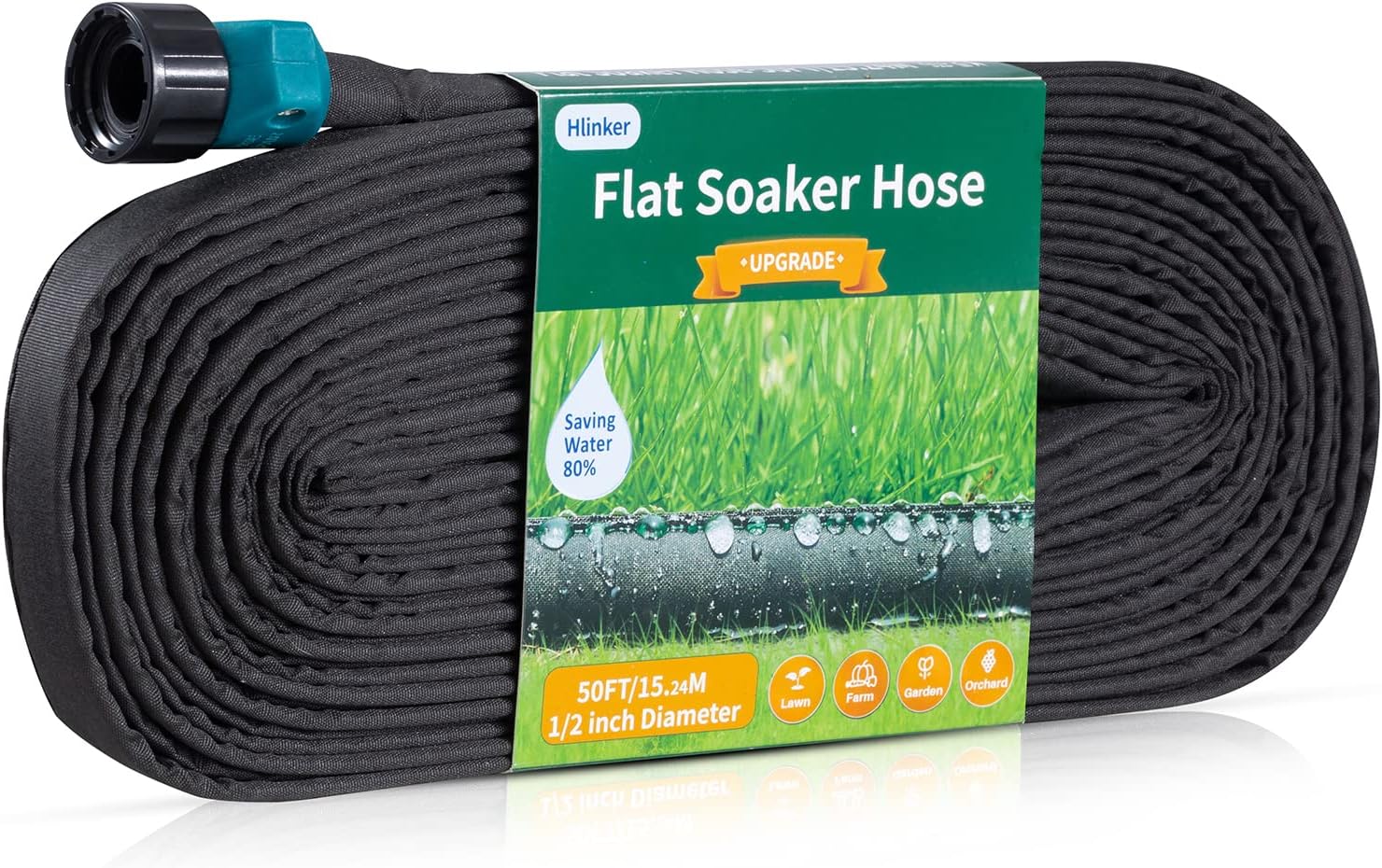
4. Hlinker Flat Soaker Hose 50 FT for Garden Beds – Best for Beginners
PROS
- +Connects end-to-end to standard garden hose threads, no special tools needed
- +Double-layer PVC and fabric build resists sun damage better than plain rubber
- +Flat, kink-resistant shape rolls up flat for easy off-season storage
- +Made from CA65-tested recycled vinyl, safe for use around edible plants
CONS
- −Not rated for water pressure above 120 PSI
- −Some buyers reported uneven water distribution over long runs
SPECIFICATIONS
| Length | 50 ft |
| Diameter | 1/2 in |
| Material | Double-layer PVC with fabric cover |
| Max Recommended Pressure | 120 PSI |
| Installation | Above ground or buried under up to 3 inches of mulch or soil |
Beginners tend to like the Hlinker soaker hose because there’s very little to figure out: attach it to a standard hose threading, link additional sections if needed, and lay it out around the plants. No emitters, barbed fittings, or drip manifolds required.
The double-layer PVC-and-fabric construction is more durable than the thin rubber weeper hoses sold at big-box stores, and the flat profile makes it simple to tuck under a layer of mulch for a cleaner look.
It’s a solid pick for garden beds, foundation plantings, and anyone who wants their first drip setup to work right out of the box without extra shopping for parts.
Get the Hlinker Flat Soaker Hose 50 FT for Garden Beds at Amazon
5. Rain Bird T22-100S Drip Irrigation 1/4″ Blank Distribution Tubing, 100′ Roll – Best for Precision Watering

PROS
- +Micro-porous design grips barbed fittings so tightly they resist accidental pull-off
- +70 PSI pressure rating exceeds many competing 1/4″ tubing products
- +Textured finish improves grip when making connections, even with wet hands
- +Long-established brand with widely available replacement fittings and stakes
CONS
- −Some buyers find it stiffer than other 1/4″ tubing when first unrolling it
- −Sold as blank tubing, so fittings and emitters are a separate purchase
SPECIFICATIONS
| Length | 100 ft roll |
| Outside Diameter | 0.25 in |
| Inside Diameter | 0.17 in |
| Pressure Rating | 0-70 PSI |
| Material | UV-resistant polyethylene resin |
Rain Bird has been making irrigation hardware since 1933, and the T22-100S reflects that experience. It’s designed to branch off larger 1/2″ tubing to deliver water precisely to individual plants, pots, or hanging baskets rather than watering broad areas.
The standout feature is the micro-porous tubing wall, which expands over barbed fittings and then shrinks back down, creating a connection that’s genuinely hard to pull apart by accident. The 70 PSI rating also gives it more headroom than most 1/4″ tubing on the market.
It shines in setups with container gardens, hanging baskets, or spot-watering needs where accuracy matters more than covering large square footage, and it’s an easy match for anyone already using other Rain Bird components.
Get the Rain Bird T22-100S Drip Irrigation 1/4″ Blank Distribution Tubing, 100′ Roll at Amazon
How to Choose the Best Drip Irrigation Hose For Garden
A drip irrigation hose is any tubing designed to deliver water slowly and directly to the base of plants instead of spraying it broadly across a lawn or garden bed. It’s built for anyone who wants healthier plants with less waste, whether that’s a homeowner with a few raised beds or someone managing a larger vegetable plot. Picking the right one matters because tubing diameter, material, and connector style all affect how well the system performs and how much maintenance it needs down the line. Getting familiar with the basics before checking out at aragrosolution.com can save you from buying the wrong size or style for your setup.
Tubing Diameter and System Type
Drip tubing generally comes in 1/4-inch and 1/2-inch (or 5/8-inch) sizes. The smaller diameter works well as branch lines running to individual pots or plants, while the larger sizes serve as the main supply line feeding an entire bed or row. Matching the diameter to your garden’s layout keeps water pressure consistent from the first plant to the last.
Material and UV Resistance
Polyethylene and PVC tubing left outdoors year-round needs UV inhibitors to avoid becoming brittle and cracking after a season or two in direct sun. Multi-layer construction, like the kind used in several of the products above, typically holds up better than single-layer tubing over multiple growing seasons.
Ready-Made Soaker Hose vs. Blank Distribution Tubing
Soaker hoses are ready to connect straight to a faucet and start watering, while blank distribution tubing requires separate emitters, connectors, and stakes. Beginners often prefer soaker hoses for the simplicity, while gardeners with more specific watering needs, like different flow rates for different plants, tend to prefer building a custom system from blank tubing.
Pressure Rating and Water Source
Every hose has a maximum operating pressure, and running a system above that rating shortens its lifespan or causes leaks at the connection points. Checking your home’s water pressure against the tubing’s rated PSI, and adding a pressure regulator if needed, helps the system last as long as it’s designed to.
Length and Coverage Area
Longer coils cost less per foot but only make sense if your garden layout actually calls for that much tubing. Buying slightly more than you need for future expansion is often smarter than running short mid-project, but stretching a single line too far can result in uneven water pressure by the far end of the run.
Maintenance, Compatibility, and Common Buyer Mistakes
Most drip irrigation problems come down to a handful of avoidable mistakes: mixing incompatible fitting sizes between brands, running tubing at pressures beyond its rating, or forgetting to flush the lines each season. According to the EPA’s WaterSense program, outdoor irrigation accounts for a large share of residential water use nationwide, and inefficient systems waste a meaningful percentage of that water to runoff and evaporation, which is exactly what a well-installed drip system is designed to prevent.
Before assembling a new system, take a few minutes to double-check that your emitters, connectors, and tubing diameters all come from compatible product lines. It’s also worth flushing the lines at the start and end of each season to clear out sediment, and disconnecting and draining tubing before the first hard freeze if you garden somewhere with cold winters.
How to Use a Best Drip Irrigation Hose For Garden Setup
Setting up a drip system doesn’t take specialized tools, just a bit of planning before you start cutting tubing. Here’s a straightforward process to follow, whether you already picked a product from our list at aragrosolution.com or are still comparing options.
- Sketch out your garden layout and measure the distance from your water source to the farthest plant, so you buy enough tubing without excessive waste.
- Connect the main line to your faucet or timer, then run branch lines or place your soaker hose along the rows or beds you want to water, keeping it close to the base of each plant.
- Add a pressure regulator if your home’s water pressure exceeds the tubing’s rating, and check all connections for leaks the first time you run water through the system.
- Inspect the system every few weeks for clogs or damaged sections, and flush the lines periodically to clear mineral buildup; the Rain Bird site has helpful seasonal maintenance guidance if you’re troubleshooting a stubborn clog or uneven flow.
Frequently Asked Questions
Q: What’s the difference between drip tubing and a soaker hose?
A: Blank distribution tubing, like the Rain Bird T22-100S (#5 on our list) or the MIXC 1/4″ tubing (#3), requires separate emitters and fittings to release water at specific points. A soaker hose, like the RAINPOINT (#1) or Hlinker (#4) options, has a porous or perforated wall that weeps water along its entire length, so it’s ready to use straight out of the box. Both approaches work well, but soaker hoses are generally simpler for beginners.
Q: How long can I run a single drip line before pressure drops off?
A: Most manufacturers recommend keeping a single connected run under 100 feet for even water distribution, which is why the RAINPOINT hose (#1) ships as two 50-foot sections rather than one continuous 100-foot line. Beyond that length, plants near the far end may receive noticeably less water than those closer to the source. If you need to cover more ground, it’s usually better to split the garden into separate zones with their own supply line.
Q: Do I need a pressure regulator for a drip irrigation hose?
A: It depends on your home’s water pressure and the tubing’s rating. The Rain Bird T22-100S (#5) is rated up to 70 PSI, while the Hlinker soaker hose (#4) can handle up to 120 PSI, so check your specific product’s limit against your household pressure. If your pressure runs high, a simple inline regulator protects the tubing and connections from premature wear.
Q: Can I bury drip tubing under mulch or soil?
A: Yes, most of the products on this list, including the Hlinker (#4) and RAINPOINT (#1) soaker hoses, are designed to work either on the surface or buried under a few inches of mulch or soil. Burying the line protects it from UV exposure and keeps it out of sight, though it also makes leaks slightly harder to spot right away.
Q: How much water can a drip system actually save compared to a regular hose or sprinkler?
A: Manufacturers across this list, including Raindrip (#2) and MIXC (#3), cite water savings in the range of 70-80% compared to overhead sprinklers, largely because drip systems eliminate runoff and reduce evaporation by targeting the root zone directly. Actual savings vary based on your soil type, climate, and how well the system is maintained, but the underlying principle holds true across most home gardens.
Final Thoughts
There’s no single best drip irrigation hose for garden use across every situation, but narrowing the decision down to tubing diameter, material durability, and whether you want a ready-made soaker hose or build-your-own distribution tubing will get you most of the way there. Any of the five options above will outperform hand-watering or an overhead sprinkler when it comes to conserving water and keeping plants consistently hydrated.
For most gardeners, the RAINPOINT Flat Soaker Hose offers the best balance of durability and ease of setup thanks to its metal fittings and ready-to-use design. If you’re covering a larger area on a tighter budget, the Raindrip 200-Foot Supply Tubing is the stronger pick for its low cost per foot and long-tested durability.