Welcome to our agro farming Rostrum . Here you can get the proper solution of your agro farming problem. We offer you enough information and guideline of modern cultivating system. We try to find out the proper way of farming that gives you maximum output. We research and analyze your farming related problem and provide proper guideline how to overcome it. We research and review of different farming tools and suggest you which tool is perfect for your farm, Lawn, And Garden. In this case we today we review Best Fungus Control for Lawn which best for Outdoor Gardening or farming. And provide the full buying guide so that you may easily choose the perfect one for you.
We tested and researched five top-rated lawn fungicides so you can find the best fungus control for lawn disease fast, whether you’re battling brown patch or dollar spot.
Brown patches, thinning grass, and powdery gray spots aren’t just an eyesore — they’re signs that fungal disease has taken hold in your turf. Warm, humid weather, poor drainage, and overwatering all create the perfect breeding ground for lawn fungus, and once it spreads, it can undo months of careful lawn care in a matter of weeks. Choosing the right product matters just as much as catching the problem early, since granules, concentrates, and ready-to-spray formulas each work a little differently depending on your lawn size, grass type, and how hands-on you want to be.
To make the decision easier, we broke down five popular options ranging from budget-friendly sprays to professional-grade concentrates. Below you’ll find a quick comparison table, followed by in-depth reviews covering the pros, cons, and specs of each product, plus a buying guide to help you apply it correctly the first time.
Our Top Picks
5 Best Fungus Control for Lawn Options, Reviewed
Our team select top five Best Fungus Control for Lawn by using their previous farming experience. Beside this they research and analysis their selected product according to the authentic customer review and the product information which is provided by the manufacturing company. They try to collect and use all the 5 product in their own farm so that they easily differentiate every characteristics of these product. Based on their analysis, research and using experience they selected top 5 Best Fungus Control for Lawn for you which is described briefly in below…
1. Scotts DiseaseEx Lawn Fungicide, 10 lbs. – Best Overall

PROS
- +Controls 26 listed lawn diseases, including brown patch, pythium blight, and red thread
- +Starts working within 24 hours of application
- +Continues controlling disease for up to 4 weeks
- +Safe for all grass types when used as directed
CONS
- −Granular form requires a spreader for even coverage
- −Works best when applied before symptoms appear, so timing matters
SPECIFICATIONS
| Form | Granules |
| Coverage | Up to 5,000 sq ft per 10 lb bag |
| Speed & Duration | Works within 24 hours, lasts up to 4 weeks |
| Diseases Controlled | 26 listed lawn diseases |
| Application Method | Broadcast, rotary, or drop spreader |
Scotts is one of the most recognized names in lawn care, and DiseaseEx backs that reputation up with sheer breadth of coverage. Very few homeowner-grade products control this many listed diseases in a single bag, which is why it earns our top spot.
In real use, the granules spread evenly with a standard broadcast or drop spreader, and reviewers consistently note visible improvement within days of the first application. It’s fast-acting without feeling like an aggressive chemical treatment.
This is the pick for homeowners who want one reliable product that handles almost any lawn disease they’re likely to encounter, without needing to research which specific fungus is present first.
Get the Scotts DiseaseEx Lawn Fungicide at Amazon
2. Atticus Gunner 14.3 MEC Propiconazole Fungicide (32oz) – Best Premium Option

PROS
- +Contains 14.3% propiconazole, the same active ingredient used in professional-grade Banner Maxx
- +Controls more than 20 turf and landscape diseases
- +Microemulsion concentrate mixes easily and won’t separate in the tank
- +Rainfast protection lasts up to 28 days once dry
CONS
- −Concentrate must be diluted and sprayed, which takes more setup than a ready-to-use product
- −Priced higher per bottle than homeowner-grade sprays and granules
SPECIFICATIONS
| Active Ingredient | 14.3% Propiconazole |
| Form | Microemulsion concentrate (mix with water) |
| Protection Window | Up to 28 days |
| Diseases Controlled | 20+, including brown patch, dollar spot, anthracnose |
| Best For | Serious lawn care enthusiasts and pros |
Gunner 14.3 MEC steps things up from consumer-grade products into territory typically reserved for golf courses and landscaping professionals. Propiconazole is a well-established systemic fungicide, and this formula is built around delivering it efficiently.
The microemulsion technology is a genuine upgrade in real use — it stays mixed in the sprayer tank instead of settling out, which means more consistent coverage from the first spray to the last. It’s also compatible for tank-mixing with other treatments.
This one suits homeowners who take their lawn seriously, have a sprayer on hand, and want the longest protection window and broadest disease list on this list, even if it costs a bit more upfront.
Get the Atticus Gunner 14.3 MEC Propiconazole Fungicide at Amazon
3. BioAdvanced Fungus Control for Lawns, Granules, 10 lb – Best Value

PROS
- +Systemic formula is absorbed into the grass so it won’t wash off with rain
- +Controls red thread, brown patch, dollar spot, and more
- +Covers 5,000 square feet per 10 lb bag
- +Up to 30 days of protection per application
CONS
- −Granules need a spreader, so it’s less convenient for spot-treating small patches
- −Doesn’t list quite as many diseases as Scotts DiseaseEx
SPECIFICATIONS
| Form | Granules |
| Coverage | Up to 5,000 sq ft per 10 lb bag |
| Protection Window | Up to 30 days |
| Diseases Controlled | Red thread, brown patch, dollar spot, and more |
| Application Method | Broadcast or drop spreader |
BioAdvanced’s granular formula hits a sweet spot between price and performance. It’s a systemic fungicide, meaning it’s taken up by the grass itself rather than just sitting on the surface, so it keeps working even after a heavy rain.
Reviewers frequently mention noticeable improvement in lawn color and density within a couple of weeks, without the sticker shock of premium concentrates. It plays nicely with an existing lawn care routine that already uses a spreader for fertilizer.
This is a solid pick for homeowners who want dependable, month-long protection at a mid-range price without stepping up to a professional-grade concentrate.
Get the BioAdvanced Fungus Control for Lawns Granules at Amazon
4. BioAdvanced Fungus Control for Lawns, Ready-to-Spray, 32 fl oz – Best for Beginners
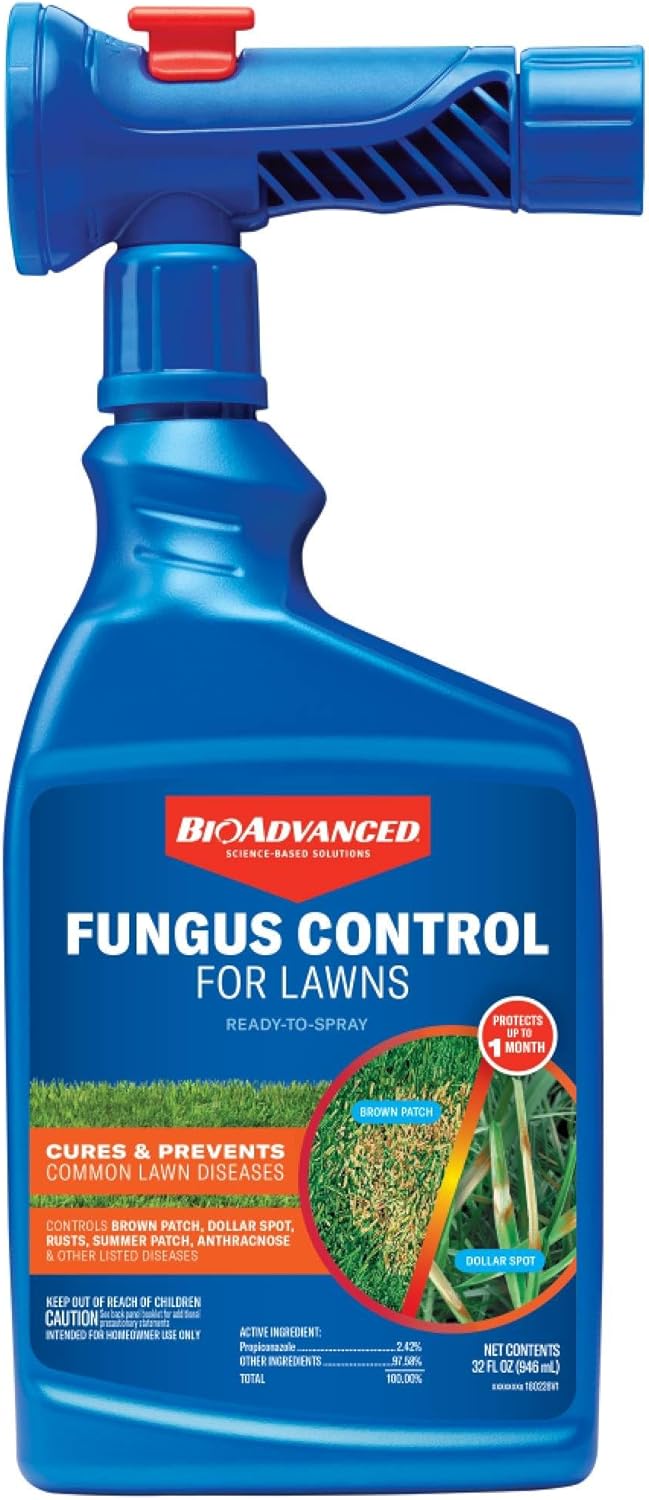
PROS
- +Hose-end sprayer attaches directly, no mixing or measuring required
- +Systemic, rainproof protection that’s absorbed into grass blades
- +Covers 5,000 sq ft per bottle
- +Up to 30 days of protection
CONS
- −Ready-to-spray bottles cover less overall lawn area per dollar than concentrates
- −Hose-end sprayers can apply unevenly if water pressure is low
SPECIFICATIONS
| Form | Ready-to-spray liquid (hose-end) |
| Coverage | Up to 5,000 sq ft per 32 fl oz bottle |
| Protection Window | Up to 30 days |
| Diseases Controlled | Red thread, brown patch, dollar spot, rust, summer patch |
| Application Method | Connects directly to a garden hose |
If you’ve never applied a lawn fungicide before, this is the least intimidating way to start. There’s no spreader calibration, no mixing ratios to get wrong — just connect the bottle to a hose and spray.
It uses the same systemic technology as BioAdvanced’s granular version, so protection isn’t compromised for the sake of convenience. Reviewers appreciate how quickly they can treat a whole yard in one pass.
It’s best suited to smaller to mid-size lawns and homeowners who’d rather spend five minutes spraying than dial in a spreader setting.
Get the BioAdvanced Fungus Control for Lawns Ready-to-Spray at Amazon
5. Garden Safe Fungicide 3, 32 Oz. Ready to Use Trigger Spray – Most Versatile

PROS
- +Doubles as an insecticide and miticide, so it’s a 3-in-1 solution
- +Made with neem oil extract for organic gardening
- +Can be used up to the day of harvest on edible plants
- +Ready-to-use trigger spray needs no mixing
CONS
- −Trigger spray suits smaller areas and garden beds better than a full lawn
- −Not labeled for the broad list of turf-specific diseases the dedicated lawn fungicides cover
SPECIFICATIONS
| Form | Ready-to-use trigger spray |
| Active Ingredient | Neem oil extract |
| Best Coverage | Spot treatment on gardens and ornamentals |
| Controls | Black spot, rust, powdery mildew, plus aphids and spider mites |
| Best For | Roses, flowers, houseplants, shrubs, fruits and vegetables |
Garden Safe Fungicide3 earns its spot on this list for versatility rather than raw turf coverage. It’s a fungicide, insecticide, and miticide in one bottle, which is handy if fungus isn’t your only problem.
Because it’s neem-oil based and safe up to the day of harvest, it’s a natural fit for anyone treating vegetable beds, roses, or landscape plantings alongside their lawn, without keeping several separate products on hand.
Think of this as the companion product to your dedicated lawn fungicide rather than a full replacement for one — ideal for spot-treating garden beds and ornamentals around the yard.
Get the Garden Safe Fungicide 3 Ready-to-Use Spray at Amazon
How to Choose the Best Fungus Control for Lawn Problems
A lawn fungicide is a treatment that stops fungal pathogens from spreading through your grass, either by preventing infection before it starts or halting it once symptoms appear. Not every lawn needs one every season — most fungal outbreaks are triggered by a specific combination of humidity, overwatering, or poor airflow — but when disease does take hold, picking the right product means the difference between a lawn that bounces back in weeks and one that stays patchy all summer. The right choice depends on your lawn size, how comfortable you are mixing and spraying, and how many diseases you’re actually dealing with.
Active Ingredient & Disease Coverage
Check the label for which diseases a product is actually registered to control. Broad-spectrum fungicides like propiconazole or azoxystrobin-based formulas cover dozens of common turf diseases, while narrower products may only target one or two. If you’re not sure what’s affecting your lawn, a broad-spectrum option is the safer starting point.
Application Method
Granules need a spreader and are easiest for treating an entire yard evenly. Ready-to-spray hose-end bottles are the most beginner-friendly, since there’s no mixing involved. Concentrates require dilution and a pump or backpack sprayer but usually stretch further per dollar, making them better suited to larger properties.
Systemic vs. Contact Protection
Systemic fungicides are absorbed into the grass blades and roots, so they keep working even after rain or irrigation. Contact fungicides sit on the leaf surface and protect only what they touch, which means they typically need more frequent reapplication, especially in wet weather.
Coverage Area & Lawn Size
Match the product’s stated square footage to your lawn size before buying. Undersizing a purchase means running out mid-treatment, while oversizing wastes money on product you won’t use before it expires.
Timing & Reapplication Interval
Most fungicides work best applied preventively, before disease symptoms appear, and offer protection windows ranging from two to four weeks. Check how often a product needs reapplying during your region’s peak disease season so you can budget for follow-up treatments.
Preventing Lawn Fungus Before It Starts
Fungicides work best as part of a broader lawn care routine rather than a standalone fix. Overwatering, mowing too short, and poor drainage all create the damp, stressed conditions fungal pathogens thrive in, so adjusting those habits can reduce how often you need to treat at all. According to the University of Missouri Extension’s turfgrass disease guide, cultural practices like proper mowing height, aeration, and watering schedules are often the first line of defense before chemical treatment is even needed.
It’s also worth checking the manufacturer’s own product page for application rates and safety guidance before you buy — for example, Scotts’ official DiseaseEx product page lists spreader settings for different application rates, which can save some trial and error on your first treatment. For more lawn care tips, browse the guides over at Agrosolution.
How to Apply a Lawn Fungicide
Follow these steps to get the most out of whichever product you choose.
- Identify the problem area and, if possible, the disease itself before buying a product, so you know it’s actually labeled to control what’s affecting your lawn.
- Apply during dry, calm weather — early morning is ideal — and follow the label’s rate for either preventive or curative treatment, since curative rates are typically higher.
- Water lightly after granular applications if the label calls for it, and avoid mowing for at least 24 hours to let the treatment settle into the turf.
- Reapply on the schedule listed on the product label, and rotate between different active ingredients if disease pressure is heavy, since alternating modes of action helps prevent resistance — visit our lawn care hub for a deeper dive into seasonal disease prevention schedules.
Frequently Asked Questions
Q: What’s the best fungus control for lawn disease if I don’t know which fungus I have?
A: Start with a broad-spectrum product that lists the most diseases on its label. The Scotts DiseaseEx Lawn Fungicide (#1 on our list) controls 26 different lawn diseases, making it a safe bet when you can’t pinpoint the exact culprit. If you want even broader, longer-lasting coverage, the Atticus Gunner 14.3 MEC (#2) is a professional-grade option worth considering.
Q: How often should I apply lawn fungicide?
A: Most products need reapplying every 14 to 28 days during active disease pressure, though exact timing depends on the label. The BioAdvanced options (#3 and #4 on our list) both offer roughly 30 days of protection per application, which lines up with a typical monthly treatment schedule.
Q: Are granules or sprays more effective?
A: Neither form is inherently more effective — both deliver the same active ingredients, just differently. Granules, like the BioAdvanced Fungus Control Granules (#3), are easier to apply evenly across a large lawn with a spreader, while ready-to-spray products like the BioAdvanced Ready-to-Spray (#4) are faster for smaller yards or quick touch-ups.
Q: Can I use a garden fungicide on my whole lawn?
A: General garden fungicides like the Garden Safe Fungicide3 (#5 on our list) aren’t formulated or labeled for full-lawn turf diseases the way dedicated lawn fungicides are. They’re better used for spot-treating garden beds, ornamentals, and edible plants alongside a proper lawn fungicide.
Q: Is it safe to let kids or pets on the lawn after treatment?
A: This depends entirely on the specific product’s label, which will state a re-entry interval. Always read and follow the label instructions on whichever product you choose, since re-entry times can vary between a few hours and a full day depending on the active ingredient and application method.
Final Thoughts
Picking the best fungus control for lawn disease really comes down to matching the product to your situation: how large your lawn is, how many diseases you’re dealing with, and how much setup you’re willing to do. Granules and ready-to-spray formulas are the easiest entry points, while concentrates offer the most coverage and longest protection for those willing to mix and spray.
For most homeowners, the Scotts DiseaseEx Lawn Fungicide offers the best balance of disease coverage and ease of use. If you need the longest-lasting, professional-strength protection and don’t mind mixing a sprayer, the Atticus Gunner 14.3 MEC is the stronger pick for its 28-day rainfast coverage.