Welcome to our agro farming site . Here you can get the proper solution of your agro farming problem. We offer you enough information and guideline of modern cultivating system. We try to find out the proper way of farming that gives you maximum output. We research and analyze your farming related problem and provide proper guideline how to overcome it. We research and review of different farming tools and suggest you which tool is perfect for your farm, Lawn, And Garden. In this case we today we review Best Fertilizer Spreader which best for Outdoor and indoor Gardening or Outdoor farming. And provide the full buying guide so that you may easily choose the perfect one for you.
Choosing the best fertilizer spreader comes down to matching hopper size, coverage width, and price to the size of your lawn.
A patchy, streaky lawn is almost never a fertilizer problem — it’s an equipment problem. Whether you’re feeding a postage-stamp front yard or maintaining a half-acre property, an uneven spreader wastes product, burns grass in some spots, and leaves other spots hungry. Handheld spreaders work fine for small areas and spot treatments, while walk-behind broadcast spreaders cover ground faster and more consistently on larger lots, and the right choice usually depends less on brand loyalty and more on how much square footage you’re actually treating each season.
We dug into five well-reviewed spreaders currently sold on Amazon — from budget handheld models to commercial-grade broadcast units — and broke down what each one actually offers in terms of capacity, build quality, and ease of use. Here’s how they stack up.
Our Top Picks
5 Best Fertilizer Spreader Review
Our team select top five Best Fertilizer Spreader by using their previous farming experience. Beside this they research and analysis their selected product according to the authentic customer review and the product information which is provided by the manufacturing company. They try to collect and use all the 5 product in their own farm so that they easily differentiate every characteristics of these product. Based on their analysis, research and using experience they selected top 5 Best Fertilizer Spreader for you which is described briefly in below…
1. EarthWay 2050P Heavy-Duty Commercial Pre-Assembled Broadcast Spreader – Best Overall

PROS
- +Huge 80 lb rustproof poly hopper covers large properties in one fill
- +Patented Even-Spread 3-hole drop shut-off system for accurate application
- +Side-spread control keeps material off flowerbeds and sidewalks
- +Arrives pre-assembled with a folding handle and 10″ pneumatic tires
CONS
- −Bulky footprint that doesn’t fold flat for storage
- −Overkill and pricier than needed for small yards under a quarter acre
SPECIFICATIONS
| Brand | EarthWay |
| Hopper Capacity | 80 lbs / 36 kg, rustproof poly construction |
| Wheels | 10″ pneumatic stud tires for uneven terrain |
| Drop System | Even-Spread 3-hole shut-off with fingertip rate control |
| Assembly | Pre-assembled with folding handle |
The EarthWay 2050P is a walk-behind broadcast spreader built for anyone treating a large yard or a handful of properties. Its 80 lb rustproof hopper and enclosed commercial-quality gearbox mean fewer refills and smoother, more consistent output over a full season of use.
In real-world use, the standout feature is the side-spread control, which lets you shut off material on one side as you pass along driveways, beds, and walkways. Combined with the three-hole drop system, it produces noticeably more even coverage than basic rotary spreaders.
This is the pick for larger residential lots, rental properties, or light commercial use. It’s an investment compared to the handheld options on this list, but the durability and precision make it worth the extra cost for anyone tired of streaky, uneven lawns.
Get the EarthWay 2050P Heavy-Duty Commercial Pre-Assembled Broadcast Spreader at Amazon
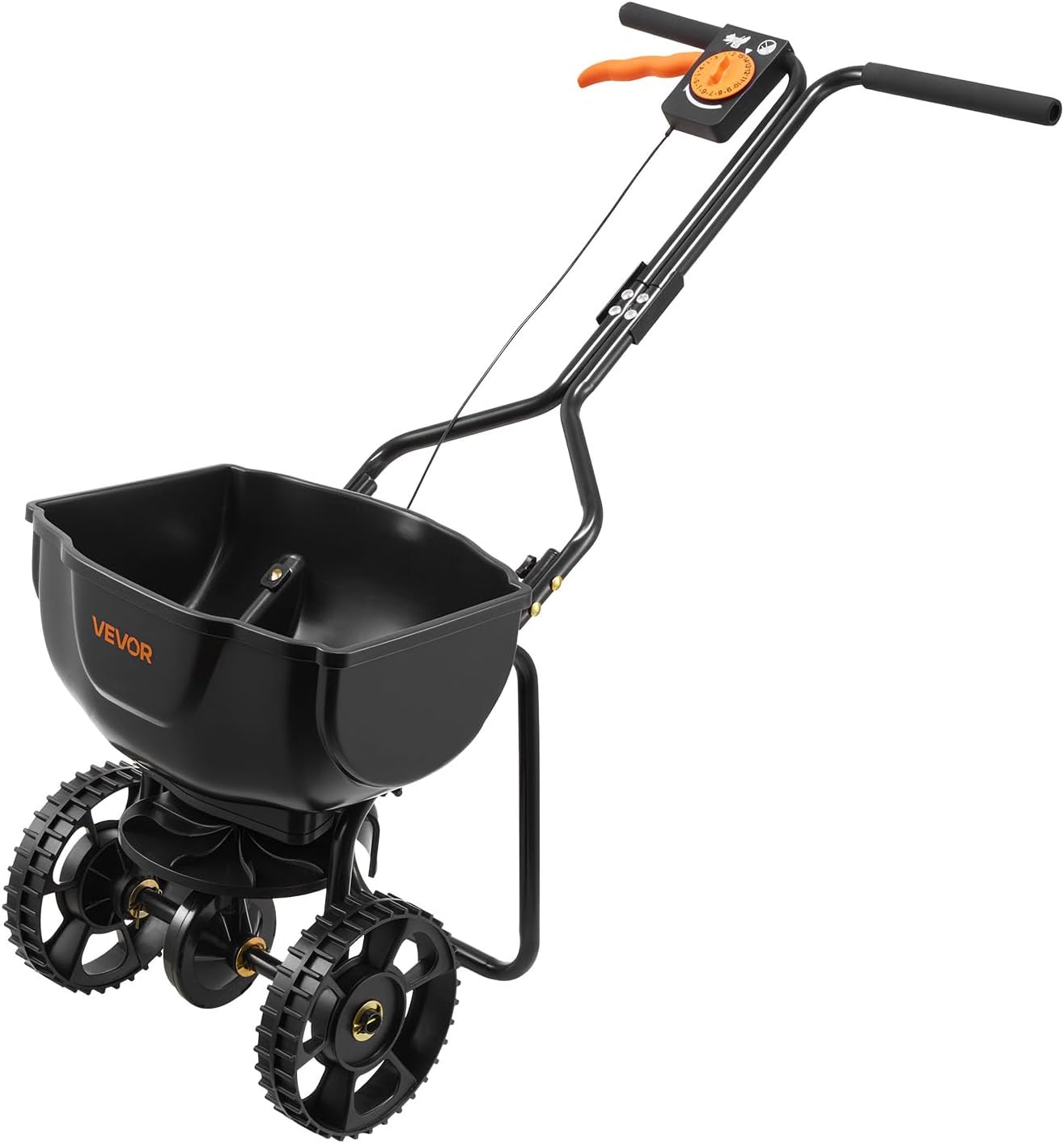
2. VEVOR Broadcast Spreader with All-Terrain Adjustable Flow Control – Best Value
PROS
- +Wide 9.8 ft spread width with 30-level adjustable settings
- +10″ all-terrain pneumatic tires handle grass, gravel, and rough patches
- +Powder-coated steel frame with a UV- and impact-resistant hopper
- +Handle and hopper detach for compact storage
CONS
- −15 lb hopper needs more frequent refills than the EarthWay on larger lots
- −Lighter-duty frame than commercial-grade competitors
SPECIFICATIONS
| Brand | VEVOR |
| Hopper Capacity | 15 lbs |
| Spread Width | 0–9.8 ft with 30-level flow adjustment |
| Wheels | 10″ pneumatic, all-terrain |
| Frame | Powder-coated steel |
The VEVOR broadcast spreader hits a sweet spot between a basic handheld unit and a full commercial rig. The 9.8 ft spread width and 30-level flow adjustment give you real control over application rate without a steep learning curve.
Where it earns its value pick is the tire setup — the 10″ all-terrain pneumatic tires roll smoothly over lumpy lawns, gravel paths, and light snow, so it doesn’t feel out of its depth outside a manicured yard. The trapezoidal hopper design also helps keep seed and fertilizer flowing evenly instead of clumping near the outlet.
It suits homeowners with mid-size yards who want walk-behind convenience without paying commercial-grade prices. Just expect a couple more refills per session than you’d get from an 80 lb hopper.
Get the VEVOR Broadcast Spreader with All-Terrain Adjustable Flow Control at Amazon
3. Amazon Basics Fertilizer Spreader for Lawn – Best Budget Pick

PROS
- +Covers up to 5,000 sq ft per load at a budget-friendly price
- +Multi-gear system for precision control over application rate
- +Steel frame with a weather-resistant plastic hopper for year-round use
- +Solid 4-star customer rating from real buyers
CONS
- −Fewer premium touches than name-brand spreaders (no side-spread control)
- −33 lb hopper limit means more refills on very large yards
SPECIFICATIONS
| Brand | Amazon Basics |
| Hopper Capacity | 33 lbs / 0.53 cubic feet |
| Coverage | Up to 5,000 sq ft per load |
| Control | Multi-gear precision control system |
| Construction | Steel frame, all-season plastic bin |
The Amazon Basics spreader proves you don’t need a big brand name to get a competent walk-behind unit. At 33 lbs of capacity and coverage up to 5,000 sq ft per load, it handles a typical suburban lawn without much fuss.
The multi-gear operation lets you dial in different rates for seed versus fertilizer versus ice melt, and the steel frame paired with an all-season plastic bin holds up reasonably well to repeated outdoor storage.
This is the pick for anyone who wants a reliable, no-frills walk-behind spreader without paying for extras like side-spread control. It’s a smart starter spreader for a first-time homeowner building out a lawn care toolkit.
Get the Amazon Basics Fertilizer Spreader for Lawn at Amazon
4. Scotts Whirl Hand-Powered Spreader for Grass Seed, Fertilizer, Salt, and Ice Melt – Best for Beginners

PROS
- +Arrives fully assembled, no tools or setup required
- +Lightweight, compact design good for small yards and spot treating
- +Adjustable arm support reduces hand and wrist fatigue
- +Versatile enough for seed, fertilizer, salt, and ice melt year-round
CONS
- −1,500 sq ft capacity per fill limits it to small properties
- −Hand-crank operation is more tiring than a walk-behind on larger areas
SPECIFICATIONS
| Brand | Scotts |
| Capacity | Holds enough product to cover up to 1,500 sq ft per fill |
| Operation | Hand-crank, hand-powered |
| Dimensions | Approx. 13″ x 8.7″ x 8.5″ |
| Assembly | Fully assembled out of the box |
The Scotts Whirl is the simplest spreader on this list, and that’s exactly the point. It’s a hand-crank handheld unit that’s ready to use straight out of the box, with an adjustable arm support that keeps extended use comfortable.
Because it’s compact and lightweight, it’s especially good for spot treating garden edges, driveways, and sidewalks where a bulky walk-behind spreader would be overkill. The crank mechanism delivers a steady, even flow as long as you keep a consistent walking pace.
It’s best suited to small yards under about 1,500 sq ft or as a secondary spreader for touch-ups. First-time lawn owners will appreciate how little there is to learn before getting started.
Get the Scotts Whirl Hand-Powered Spreader at Amazon
5. Walensee Handheld Bag Seed Spreader with Adjustable Flow Control – Most Portable

PROS
- +25 lb Oxford bag with a padded shoulder strap for comfortable carrying
- +Enclosed metal gears and a rear baffle protect the mechanism and your clothes
- +3D support frame keeps the bag upright and easy to refill
- +Great for tight spaces, slopes, and areas a wheeled spreader can’t reach
CONS
- −Manual crank means more physical effort over large areas
- −25 lb bag capacity is the smallest of the group
SPECIFICATIONS
| Brand | Walensee |
| Capacity | 25 lbs, durable Oxford fabric bag |
| Gears | Enclosed metal gears with rear baffle |
| Carry System | Adjustable padded shoulder strap |
| Flow Control | Adjustable gate opening, multiple settings |
The Walensee handheld spreader trades a hopper and wheels for a shoulder-slung bag, which makes it the most maneuverable option here. It’s built for gardens, narrow side yards, and hilly terrain where a walk-behind unit would struggle.
The enclosed metal gears and rear baffle are nice touches at this price point — they keep material from spraying back at you and hold up better over time than plastic gear systems on cheaper handheld spreaders. The rigid frame also keeps the bag open for easy one-handed refills.
It suits gardeners and homeowners with irregularly shaped or sloped lots more than anyone managing a wide-open lawn. Pair it with one of the wheeled options above if you need both precision spot treatment and broad coverage.
Get the Walensee Handheld Bag Seed Spreader at Amazon
How to Choose Best Fertilizer Spreader
A fertilizer spreader is any tool that helps you apply granular lawn products — fertilizer, grass seed, salt, or ice melt — in an even layer across a target area. Getting the right one matters because under-application leaves patchy, thin turf while over-application wastes money and can burn or damage grass. Picking the best fertilizer spreader for your situation mostly comes down to matching hopper capacity and spread pattern to your yard size, then weighing that against how much storage space and budget you have available.
Hopper or Bag Capacity
Capacity determines how often you’ll need to stop and refill. Small handheld spreaders like the Scotts Whirl or Walensee bag hold under 30 lbs and suit yards under a couple thousand square feet. Walk-behind units like the EarthWay 2050P scale up to 80 lbs, letting you treat larger properties in a single pass without constant refilling breaks.
Spread Width and Pattern
Broadcast spreaders throw material in a wide fan-shaped pattern, covering more ground per pass than drop spreaders, which release product in a narrow strip directly beneath the hopper. A wider, adjustable spread width — like the VEVOR’s 9.8 ft range — cuts down on the number of passes needed, but broadcast spreaders require more care near flowerbeds and hardscaping to avoid overspray.
Flow Control and Calibration
Look for a spreader with multiple, clearly marked flow settings so you can match the output rate to whatever product you’re using that day. Fertilizer, grass seed, and ice melt all have different particle sizes and flow differently through the same gate opening, so a spreader with fine-grained adjustment gives more accurate, less wasteful results.
Build Quality and Weather Resistance
Fertilizer and ice melt are both corrosive to metal parts over time, so rustproof poly hoppers and enclosed, sealed gear systems last significantly longer than exposed metal components. Powder-coated steel frames, like those on the VEVOR and EarthWay models, resist rust better than bare steel if you plan to leave the spreader in a garage or shed rather than fully weatherproof storage.
Terrain and Mobility
If your yard has slopes, gravel paths, or uneven ground, tire size and type matter as much as hopper capacity. Pneumatic (air-filled) tires in the 8–10 inch range roll more smoothly over bumps and soft turf than small plastic wheels, which can bog down or leave ruts on wet grass.
Fertilizer Spreader Calibration and Maintenance
Even the best fertilizer spreader will apply product unevenly if it isn’t calibrated to the material you’re using. University turf programs recommend a simple calibration check: weigh out a measured amount of product, run the spreader over a known area, then weigh what’s left to calculate your actual application rate per 1,000 square feet, adjusting the flow setting up or down until it matches the product label’s recommendation, as detailed in the Clemson Cooperative Extension’s spreader calibration guide.
Maintenance matters just as much as calibration. Fertilizer and ice melt are corrosive, so rinse the hopper, gears, and frame with water after every use and let the spreader dry fully before storing it, ideally in a covered, dry space to prevent rust from forming on metal components.
How to Use Best Fertilizer Spreader
Getting consistent results is less about the spreader itself and more about technique. Follow these steps for even coverage every time.
- Measure your lawn. Know your total square footage before you start so you can calculate how much product to load and how many passes you’ll need.
- Set the flow rate. Check the product bag for a recommended spreader setting, or start conservatively and adjust after a test pass. Fill the hopper away from paved surfaces to avoid stray spills.
- Walk in overlapping, straight rows. Close the gate at the ends of each pass and turns to avoid double-dosing corners, and walk at a steady pace since speed affects how wide and even the spread pattern is.
- Clean and calibrate regularly. Rinse the spreader after each use to prevent corrosion, and periodically re-check your calibration, following a resource like the UMass Extension’s rotary spreader calibration procedures, especially after switching to a new fertilizer or seed product with a different particle size.
Frequently Asked Questions
Q: What’s the difference between a broadcast spreader and a drop spreader?
A: A broadcast spreader, like the EarthWay 2050P (#1 on our list) or the VEVOR (#2), throws material outward in a wide fan pattern, covering more ground per pass. A drop spreader releases product straight down in a narrow strip matching the hopper’s width. Broadcast spreaders are faster for open lawns, while drop spreaders offer more precision near beds and walkways since there’s no chance of overspray.
Q: How much lawn can one handheld spreader treat?
A: It depends on the model, but handheld spreaders in this roundup range from about 1,500 sq ft per fill on the Scotts Whirl (#4) up to roughly 25 lbs of product capacity on the Walensee bag spreader (#5). Both are best suited to small yards, garden beds, or spot treatments rather than large open lawns.
Q: Is a walk-behind spreader worth it for a small yard?
A: For yards under a few thousand square feet, a handheld spreader is usually lighter, cheaper, and easier to store. Once you’re regularly treating more than about a quarter acre, a walk-behind broadcast spreader like the Amazon Basics (#3) or VEVOR (#2) saves time and reduces fatigue compared to hand-cranking.
Q: Can I use the same spreader for fertilizer, grass seed, and ice melt?
A: Most spreaders on this list, including the Scotts Whirl (#4) and EarthWay 2050P (#1), are designed to handle all three. Just be sure to rinse and dry the hopper thoroughly between uses, since leftover fertilizer or salt residue can corrode metal parts and clog the flow gate over time.
Q: How do I know what spreader setting to use?
A: Most fertilizer and seed bags include a settings chart that lists common spreader brands alongside recommended numbers. If your spreader isn’t listed, start on a low-to-mid setting, run a test pass over a measured area, and adjust based on how much product was actually applied, as outlined in university extension calibration guides.
Final Thoughts
There’s no single best fertilizer spreader for every yard — the right pick depends almost entirely on how much ground you’re covering and how often. Larger properties benefit from a bigger hopper and broadcast control, while smaller lots and garden beds are usually better served by a lightweight handheld unit that’s easy to store and maneuver.
If you’re treating a mid-size to large lawn and want the most consistent results, the EarthWay 2050P offers the best balance of capacity and precision for the price. If you need something lighter for a small yard or tight garden spaces, the Walensee handheld spreader is the stronger pick for its portability and comfort strap on sloped or hard-to-reach ground. Whichever you choose, check out our full lawn care buying guides at Agrosolution for more tips on getting the most out of your equipment, and browse our seasonal lawn care checklist on Agrosolution before your next application.