Welcome to our agro farming site . Here you can get the proper solution of your agro farming problem. We offer you enough information and guideline of modern cultivating system. We try to find out the proper way of farming that gives you maximum output. We research and analyze your farming related problem and provide proper guideline how to overcome it. We research and review of different farming tools and suggest you which tool is perfect for your farm, Lawn, And Garden. In this case we today we review Best Seed Spreader which best for Outdoor Gardening or Outdoor farming. And provide the full buying guide so that you may easily choose the perfect one for you.
Not sure which spreader will get seed down evenly without wasting half the bag on your driveway? We tested the top five options so you don’t have to guess.
A good lawn starts long before the first blade of grass pokes through the soil — it starts with even, accurate coverage. Whether you’re overseeding a few bare patches or reseeding a full quarter-acre, the tool you push, tow, or crank across the yard determines whether your seed lands where it’s supposed to or drifts into the flower beds. Walk-behind broadcast units, tow-behind hoppers, hand-crank shoulder spreaders, and even row-style garden seeders all solve slightly different problems, so matching the tool to the job matters more than chasing the biggest hopper on the shelf.
Below, we break down five well-reviewed spreaders that cover everything from quarter-acre lawns to raised garden beds, so you can find the one that fits your yard, your budget, and your patience for assembly.
Our Top Picks
5 Best Seed Spreader Review
Our team select top five Best Seed Spreader by using their previous farming experience. Beside this they research and analysis their selected product according to the authentic customer review and the product information which is provided by the manufacturing company. They try to collect and use all the 5 product in their own farm so that they easily differentiate every characteristics of these product. Based on their analysis, research and using experience they selected top 5 Best Seed Spreader for you which is described briefly in below…
1. Scotts Turf Builder EdgeGuard DLX Broadcast Spreader – Best Overall

PROS
- +EdgeGuard technology blocks the right side of the pattern so product stays off driveways and beds
- +Curved hopper and dual-bladed agitator funnel product smoothly for consistent flow
- +Arrives pre-calibrated and ready to use for Scotts-branded lawn products
- +One of the most recognized and widely stocked spreader brands
CONS
- −Rate settings are calibrated around Scotts products, so third-party seed needs manual testing
- −Still requires walking the full yard, unlike tow-behind models
SPECIFICATIONS
| Brand | Scotts |
| Type | Walk-behind broadcast spreader |
| Capacity | Holds enough product to cover up to 15,000 sq. ft. |
| Signature Feature | EdgeGuard edge-control shutoff |
| Best Used For | Fertilizer, grass seed, granular weed killer, salt, and ice melt |
The Scotts Turf Builder EdgeGuard DLX earns the top spot because it’s the most balanced pick on this list — accurate, pre-calibrated, and built specifically to keep seed and fertilizer off hard surfaces. A curved hopper and dual-bladed agitator keep material funneling evenly instead of clumping mid-pass.
In real use, the EdgeGuard shutoff is the standout feature: engage it along a driveway or sidewalk and the spreader automatically blocks the right side of its pattern, so you don’t have to sweep excess seed off the pavement afterward.
It suits homeowners with mid-size to large lawns who want a set-it-and-go experience without fussing over manual calibration charts. For most yards, it’s the safest first purchase on this list.
Get the Scotts Turf Builder EdgeGuard DLX Broadcast Spreader at Amazon
2. Agri-Fab 45-0530-131 85 lb. Tow Broadcast Spreader – Best for Large Lawns

PROS
- +85-lb hopper covers up to roughly a quarter acre (14,000 sq. ft.) per fill
- +Tows behind a riding mower or lawn tractor so you never have to push it
- +10-inch pneumatic tires roll smoothly over bumps and uneven turf
- +Enclosed gearbox keeps seed and fertilizer from fouling the internal drive
CONS
- −Needs a riding mower or ATV to tow, so it isn’t suited for handheld use
- −Some owners report the cable flow-control lever feels less durable than the rest of the frame
SPECIFICATIONS
| Brand | Agri-Fab |
| Type | Tow-behind broadcast spreader |
| Capacity | 85 lb. hopper, up to 14,000 sq. ft. coverage |
| Tires | 10-inch pneumatic |
| Control | Cable-operated flow control, enclosed gearbox |
If your property is too big to comfortably cover on foot, this Agri-Fab tow spreader takes the walking out of the equation entirely. Hitch it to a riding mower and it hauls enough material to blanket roughly a quarter acre without a refill.
The rustproof poly hopper and enclosed gearbox hold up well against the abrasive nature of seed and fertilizer, and the pneumatic tires smooth out the ride over rougher sections of yard. The included cable flow control lets you open and close the gate from the mower seat.
It’s the right call for large or hilly properties where a walk-behind unit would mean hours of pushing. Just budget time to fine-tune the flow lever, since a few buyers note it needs a firm hand.
Get the Agri-Fab 85 lb. Tow Broadcast Spreader at Amazon
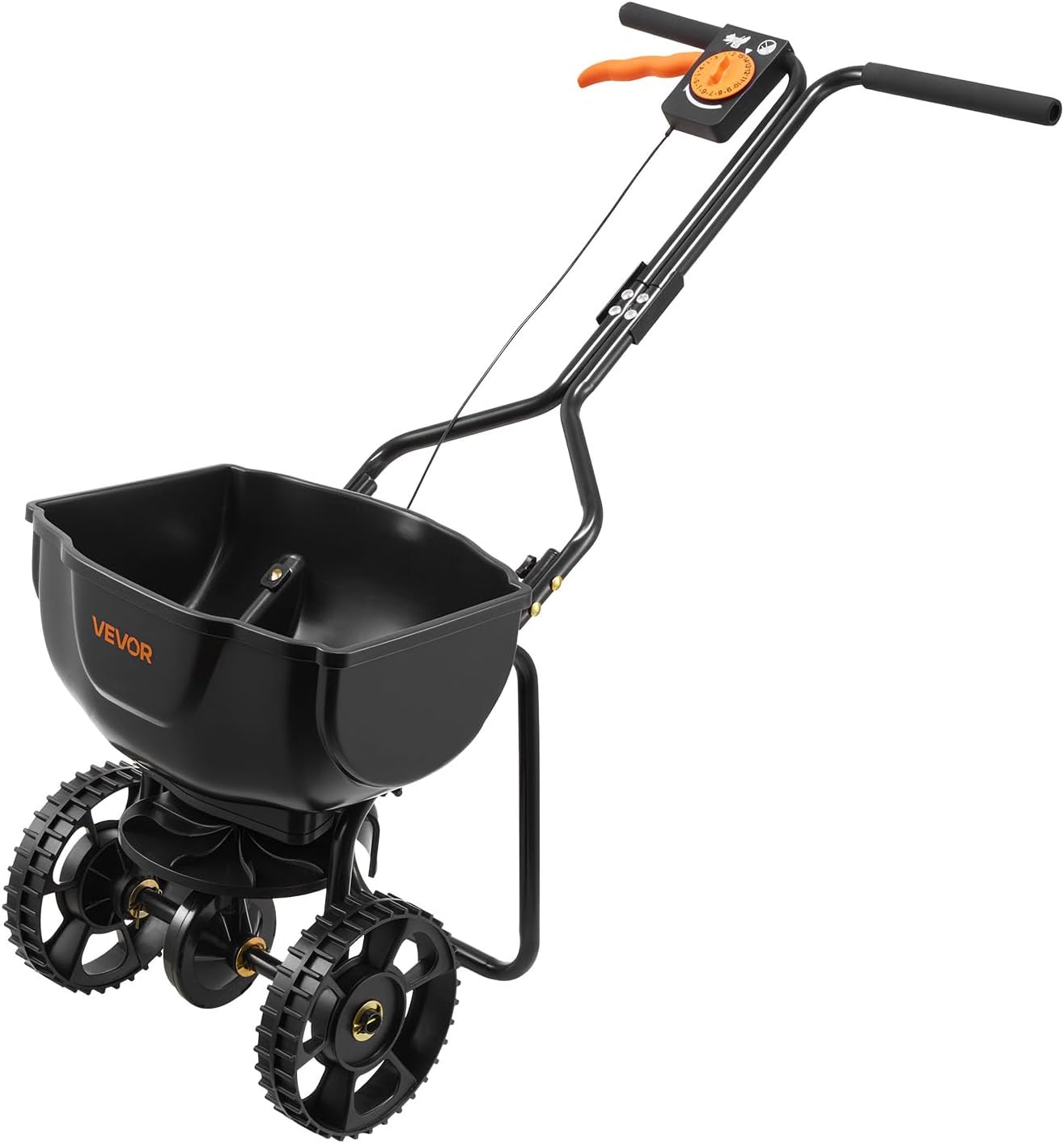
3. VEVOR Adjustable Push Broadcast Spreader – Best Budget Pick
PROS
- +Adjustable spread width from 0 to 9.8 feet with 30 precise scale settings
- +Trapezoidal hopper design promotes an even seed drop instead of clumping
- +10-inch all-terrain tires handle both smooth lawns and rougher ground
- +Pre-installed core components allow assembly in just a few steps
CONS
- −15-lb hopper capacity means more refills on larger properties
- −Lighter-duty frame built more for occasional home use than daily professional work
SPECIFICATIONS
| Brand | VEVOR |
| Type | Walk-behind push spreader |
| Capacity | 15 lb. hopper |
| Spread Width | Adjustable, 0–9.8 ft. |
| Tires | 10-inch all-terrain |
For anyone who just wants an affordable, no-fuss spreader for a small or mid-size yard, this VEVOR model checks the boxes. It’s light on the wallet without skipping the adjustable flow control that pricier units offer.
The 30-position scale lets you fine-tune the outlet size for seed, fertilizer, or salt, and the trapezoidal hopper keeps material moving evenly instead of bridging near the gate. Assembly is quick since most parts arrive pre-installed.
It’s best suited to homeowners with smaller lots who don’t need an 80-plus-pound hopper. Larger yards will mean a few extra hopper refills, but the price makes that a fair trade-off.
Get the VEVOR Adjustable Push Broadcast Spreader at Amazon
4. EarthWay 2750 Shoulder Spreader – Best for Spot Seeding

PROS
- +Hip-mounted, cross-shoulder design is easy to maneuver on hills or wet, uneven ground
- +Oscillating shuttle agitator helps prevent seed from clumping in the bag
- +Heavy-duty nylon bag resists tearing and rotting better than typical hoppers
- +Infinite flow-control lever lets you dial in exact output for small areas
CONS
- −Hand-crank operation takes more physical effort than a wheeled spreader
- −25-lb capacity means covering a full lawn will require several refills
SPECIFICATIONS
| Brand | EarthWay |
| Type | Hand-crank hip/shoulder spreader |
| Capacity | 25 lb. nylon bag hopper |
| Signature Feature | Oscillating shuttle agitator, spring-close shutoff |
| Best Used For | Spot seeding, hard-to-reach corners, hilly or wet terrain |
Not every job calls for a wheeled spreader, and that’s where the EarthWay 2750 fits in. It’s built to ride on your hip with a cross-shoulder strap, which makes it far more nimble than a push spreader on slopes, soft ground, or tight side-yard passes.
Inside the tough nylon bag, an oscillating shuttle keeps seed and fertilizer moving so it doesn’t bridge or clump, while a spring-close shutoff lets you stop the flow instantly when you turn or pause.
It’s a great secondary tool for patching bare spots or reseeding areas a wheeled spreader can’t reach, though covering an entire lawn with it will take more cranking than a walk-behind unit.
Get the EarthWay 2750 Shoulder Spreader at Amazon
5. Chapin 8701G Garden Push Seeder Planter – Best for Row Gardening

PROS
- +Six interchangeable seed plates support up to 20 varieties of vegetable seed
- +Zinc-coated plow blade opens the furrow automatically as you push
- +Built-in row marker helps keep straight, evenly spaced planting rows
- +Powder-coated steel frame is built to resist rust in garden soil
CONS
- −Built for row-by-row garden planting rather than broad lawn coverage
- −Not intended for fertilizer, salt, or ice melt like the other spreaders on this list
SPECIFICATIONS
| Brand | Chapin |
| Type | Push garden row seeder / planter |
| Seed Plates | 6 plates, supports up to 20 seed varieties |
| Frame | Powder-coated steel |
| Signature Feature | Plow blade plus adjustable row marker |
The Chapin 8701G isn’t a broadcast spreader — it’s a precision row seeder, and that makes it the odd one out on this list in the best way. If your seeding needs are more vegetable garden than front lawn, this tool plants in straight, evenly spaced rows instead of scattering seed broadly.
Swap between the six included plates to match different seed sizes, from carrots to beans, while the plow blade cuts the furrow and closes it behind you in a single pass. The row marker keeps the next line straight without guesswork.
It’s the pick for gardeners who want organized rows rather than a blanket lawn application — pair it with one of the broadcast spreaders above if you need both.
Get the Chapin 8701G Garden Push Seeder Planter at Amazon
How to Choose a Seed Spreader
A seed spreader is any tool designed to distribute grass seed, fertilizer, or similar granular material evenly across the ground, and choosing the right one really comes down to matching its design to your property. A walk-behind broadcast spreader suits mid-size lawns, a tow-behind unit suits large or hilly acreage, a shoulder-mounted model suits spot repairs, and a row seeder suits vegetable gardens rather than turf. Picking the wrong category means either wasting time on refills or overspending on capacity you’ll never use, so start by sizing up the area you actually need to cover before comparing brands or features.
Spreader Type
Broadcast (rotary) spreaders fling material in a wide fan pattern and cover ground quickly, while drop spreaders release it in a straight line directly beneath the hopper for tighter control near edges. Hand-crank shoulder models trade speed for maneuverability in tight or uneven spaces, and row seeders are built specifically for garden beds rather than open lawn. Match the type to the terrain and material you’ll be spreading most often.
Hopper Capacity and Coverage
Hopper size determines how much ground you can cover before stopping to refill. Small hoppers around 15–25 lbs suit modest yards or spot treatments, while 80-plus-lb hoppers are built for quarter-acre lots and beyond. Check the manufacturer’s listed coverage area in square feet, since capacity varies by the density of the material being spread.
Spread Width and Pattern Control
Wider spread patterns mean fewer passes across the yard, but they also require more overlap discipline to avoid stripes of uneven growth. Features like edge-guard shutoffs are worth prioritizing if your lawn borders driveways, sidewalks, or garden beds where overspray wastes product and creates cleanup.
Build Material and Tires
Rustproof poly or nylon hoppers hold up far better than untreated metal when exposed to fertilizer and damp seed. Pneumatic tires roll more smoothly over bumpy or sloped terrain than solid plastic wheels, which matters most on properties with uneven ground.
Calibration and Flow Control
The best spreader is only as accurate as its calibration. Look for models with clear, numbered flow settings and, ideally, a published setting chart for common seed and fertilizer brands. A properly calibrated spreader avoids the two most common mistakes: under-application, which leaves patchy growth, and over-application, which wastes product or burns the lawn.
Seed Spreader Maintenance and Calibration Tips
Spreaders should be recalibrated for each new product, since seed, fertilizer, and ice melt all vary in size, weight, and density — a setting dialed in for grass seed will not deliver the correct rate for a granular fertilizer. Clemson University’s Home & Garden Information Center notes that spreaders are used to apply dry granular materials such as fertilizer, pesticides, lime, or seed, and that rotary and drop spreaders distribute those materials differently across the lawn, which is why checking the settings chart before each new application matters. Rinse the hopper after every use, let it dry fully before storage, and inspect the gate mechanism periodically for corrosion, since that’s typically the first part to wear out on a budget spreader.
How to Use a Seed Spreader
Getting even coverage takes more than just filling the hopper and walking in a straight line. Follow these steps for a cleaner, more consistent result.
- Measure your lawn’s square footage and check the seed bag’s recommended application rate so you know roughly how much product you’ll need.
- Fill the hopper over a hard surface like a driveway to avoid spilling excess seed directly onto the grass, then set the flow control to the manufacturer’s suggested starting position.
- Walk at a steady, consistent pace and overlap each pass by about a third of the spread width to prevent thin stripes between rows.
- Release the trigger or lever whenever you turn or stop to avoid over-applying in one spot, then empty and rinse the hopper when finished. For a deeper walkthrough of setting charts and pass spacing, Scotts’ own product guidance on the Elite Spreader page is a useful reference before your first application.
Frequently Asked Questions
Q: What is the best seed spreader for a typical suburban lawn?
A: For most quarter-acre-and-under suburban lawns, the Scotts Turf Builder EdgeGuard DLX (#1 on our list) is the easiest starting point, since it’s pre-calibrated and includes edge control for driveways and sidewalks. If your lot runs closer to a full quarter acre or has hills, the Agri-Fab 85 lb. Tow Spreader (#2) removes the walking altogether. Either one will outperform a basic hand-crank model on a standard-size yard.
Q: Do I need a different spreader for seed versus fertilizer?
A: Not necessarily a different spreader, but you do need different calibration settings. Grass seed is generally much lighter and finer than granular fertilizer, so a setting dialed in for feed will typically over-apply seed. Models like the EarthWay 2750 (#4) and the VEVOR push spreader (#3) both offer adjustable flow controls that make switching between materials straightforward.
Q: What’s the difference between a broadcast spreader and a drop spreader?
A: A broadcast (rotary) spreader flings material outward in a wide fan, covering more ground per pass but requiring careful overlap to avoid uneven stripes. A drop spreader releases material in a straight line directly under the hopper, giving tighter control near edges and beds at the cost of slower coverage. All five spreaders in this roundup except the Chapin row seeder (#5) are broadcast-style units.
Q: Can I use a broadcast spreader for a vegetable garden?
A: Broadcast spreaders work fine for cover crops or lawn-style seeding, but they’re not designed for organized row planting. For structured vegetable rows with consistent spacing, a dedicated row seeder like the Chapin 8701G (#5) is the better tool, since it opens the furrow, drops the seed, and closes the row in a single pass.
Q: How do I know what hopper size I actually need?
A: Start with your lawn’s square footage and compare it to each spreader’s listed coverage. Smaller hoppers around 15–25 lbs, like the VEVOR (#3) or EarthWay 2750 (#4), suit yards under a few thousand square feet or spot-seeding jobs. Larger hoppers in the 60–85 lb range, like the Agri-Fab tow spreader (#2), are built for properties approaching a quarter acre or more.
Final Thoughts
There’s no single best seed spreader for every yard — the right pick depends on lawn size, terrain, and whether you’re seeding turf or planting a garden row by row. Prioritize accurate calibration and a hopper size that matches your property, and you’ll waste less product while getting more even results with every pass.
For most homeowners, the Scotts Turf Builder EdgeGuard DLX offers the best balance of accuracy, calibration, and driveway-friendly edge control. If your property is bigger than most and hooking up to a mower is an option, the Agri-Fab 85 lb. Tow Spreader is the stronger pick for its larger hopper and hands-free towing.