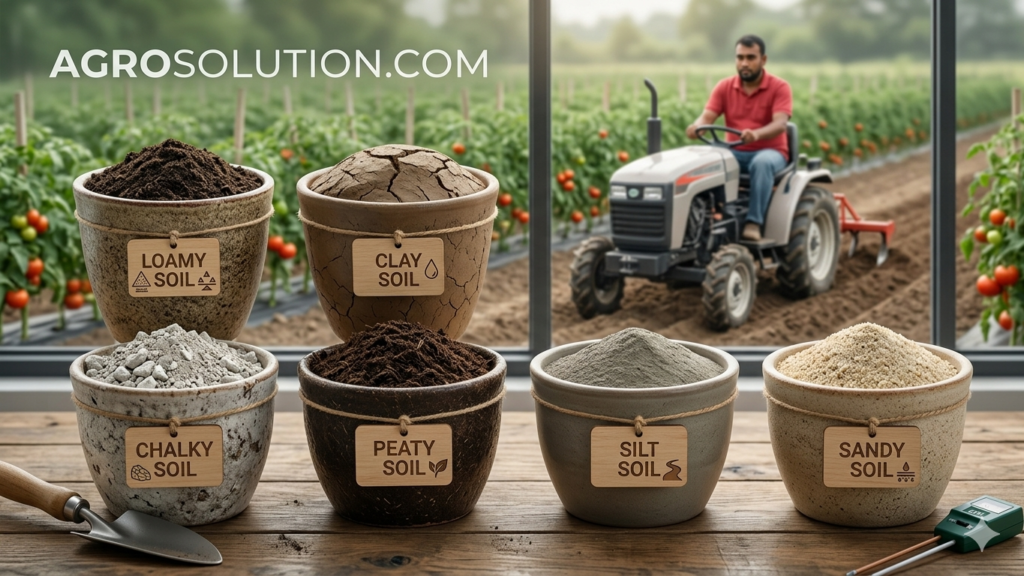
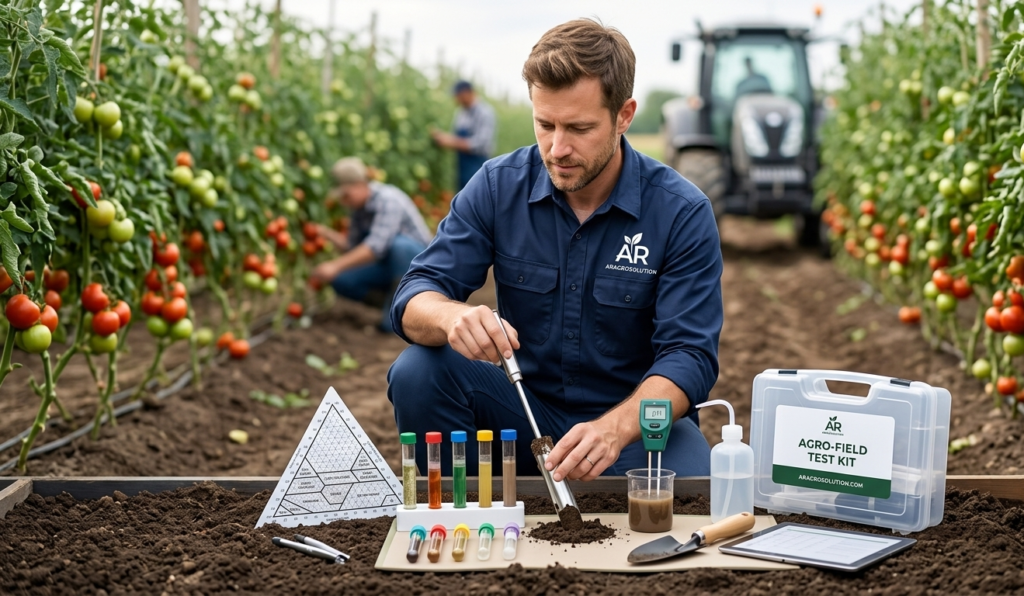
When people ready to start farming they search for the best soil for agriculture, they assume there is this one magical soil that solves everything. But, you need to make the best soil for agriculture by mixing up all the ingredient that a plant need to grow up well, only if farming worked that way!
In the world of commercial farming and high-yield crop management, there is a common misconception that the most productive soil must be purely rich, dense, and dark. Landowners often assume that if clay holds the most minerals, or if silt holds the most water, then a field made entirely of one dominant element would yield the best results.
In this article we approach land management through the lens of precision agriculture. The data consistently proves a different reality: in farming, extremes create bottlenecks. The undisputed champion for global food production isn’t a single “pure” soil type—it is a finely tuned, structural compromise known as “Loamy Soil“.
Understanding why a balanced soil profile is the true engine behind premium harvests is the first step toward maximizing your plantation’s potential.
The Anatomy of the Perfect Mix: The 20-40-40 Rule
To understand why a blend performs better than its individual parts, we have to look at the physical components of agricultural earth. Soil texture is determined by the ratio of three geological particles:
- Sand,
- Silt,
- Clay
When these three are mixed into an ideal ratio, they form a loam. For most high-value crops—including premium tomato plantations—the optimal agricultural blueprint follows a precise formula:
- 20% Clay: The mineral anchor that prevents nutrient leaching.
- 40% Silt: The fertile binder that retains steady moisture.
- 40% Sand: The structural aerator that ensures drainage.
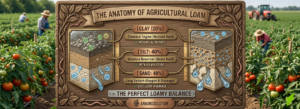
Each of these particles brings a distinct “superpower” to the field. However, when left on their own, those same superpowers become liabilities.
Why “Pure” Soils Fail the Yield Test
To truly appreciate the value of a balanced mix, we must examine the agricultural failures that occur at the structural extremes.
1. The Perils of Pure Sand (The Sieve)
Sand particles are large, gritty, and irregular. Because they don’t pack together tightly, they create massive macro-pores that allow water to pull straight down through the earth.
The Flaw: While sand warms up quickly in the spring and offers zero resistance to root expansion (making it popular for crops like peanuts), it cannot hold onto inputs. Water rushes through it like a sieve, dragging water-soluble nitrogen and potassium deep into the water table, completely out of reach of your plants.
2. The Danger of Pure Clay (The Brick)
On the opposite end of the spectrum, clay particles are microscopic, flat plates that pack together tightly with minimal air space.
The Flaw: Clay is a chemical powerhouse with an incredible capacity to store nutrients. However, its tight structure makes it highly prone to waterlogging and severe compaction. When wet, it drives out oxygen, suffocating root systems and breeding anaerobic root rot pathogens. When dry, it bakes into an impenetrable brick that physically stunts root development.
3. The Fragility of Pure Silt (The Crust)
Silt particles are intermediate in size, feeling smooth and flour-like to the touch. It is highly fertile and holds water beautifully.
The Flaw: Because silt particles are uniform and lightweight, they lack structural integrity. Without sand to create drainage or clay to chemically bind the particles together, pure silt easily loses its structure. A single heavy rainfall can cause a silty field to run off, erode, or pack down into a dense, compacted surface crust that blocks oxygen and stops new seedlings from breaking through.
The Synergy of the Blend: How Loam Solves the Puzzle
When you create a balanced mix, a beautiful mechanical synergy takes place. The strengths of one particle actively neutralize the weaknesses of another.
Micro-pores vs. Macro-pores
A balanced loamy soil contains a healthy distribution of both large and small spaces between its particles.
The sand component guarantees the presence of macro-pores (air channels). This ensures that after a heavy downpour, excess water drains away within hours, pulling fresh oxygen down into the root zone so the plant can breathe.
The clay and silt components contribute micro-pores (tiny water pockets). While the sand clears out the excess water, the clay and silt trap just enough moisture against the pull of gravity to keep root hairs hydrated during dry spells.
Cation Exchange Capacity (CEC)
From a chemical standpoint, clay particles possess a strong negative electrical charge. This charge allows them to attract and hold onto positively charged plant nutrients (cations) like calcium, magnesium, and potassium.
In a pure clay field, these nutrients are held so tightly that roots struggle to extract them. In a balanced loam, the presence of sand and organic humus loosens the physical environment. This allows roots to easily navigate the soil architecture, approach the clay particles, and efficiently exchange ions to feed the plant.
Biological Vitality Thrives in Balance
Soil health isn’t purely a mechanical or chemical equation; it is deeply biological. A field is only genuinely suitable for high-yield agriculture if it supports a thriving underground ecosystem.
Subterranean life—from beneficial mycorrhizal fungi to earthworms—requires a stable home. Biological audits show that earthworms will completely abandon heavy, compacted clay or dry, shifting sand. They thrive in a balanced loam because the texture remains loose enough for them to tunnel through, yet damp and structurally secure enough to hold their burrows open.
When you engineer a balanced soil texture, you are directly investing in the biological workforce that naturally tills, fertilizes, and immunizes your crops against disease.
The ARAGROSOLUTION Philosophy: Engineering Your Balance
Very few agricultural projects inherit a perfect, natural 20-40-40 loam balance right out of the box. Achieving top-tier agricultural resilience means understanding what your specific acreage lacks and actively amending it.
If your ground is too heavy which is known as Clay dominant we introduce coarse builder’s sand and high-quality organic compost to split the dense plates and create much-needed macro-pores. On the other hand if your ground is too thirsty like sand dominant we integrate well-aged manure and peat moss to act as a biological adhesive, slowing down water movement and locking in valuable nutrients.
In modern cultivation, you do not have to accept the hand that nature dealt your land. By treating soil structure as an engineered foundation rather than permanent dirt, you unlock the predictability, safety, and explosive yield capacity that defines precision farming.
Loamy soil: The Best Soil for Agriculture
The reason why loamy soil is considered the best soil for agriculture is not that it is always naturally great, but because:
- It holds water
- But does not gold do too much
- It drains well
- But does not drain too fast
- It stores nutrients
- And releases them to the roots gently
In single words, it’s a balanced soil that has the best of all soil does the world have. And here is a truth: farmers don’t find loamy soil they built it. They do it with organic matter, mulching, compost, crop rotation, and natural amendments by mixing with right portion. By this way farmers make their soil better every year.
You just start your farming, even if your land doesn’t start with loamy soil, because consistent care can turn it into the best soil for agriculture over time.
For more information and clear concept you may watch this video….